
Illinois Turner Camp History
ChicagoScripts
The camp's history, read aloud at reunions — from the Turnverein movement in Germany to the Fox River today.
Chicago Scripts
1914–1940s: FRISCH – FRESH
Pre-History (read by Laura Land)
Founded in Germany in 1811 by Friedrich Ludwig Jahn, the Turnverein movement combined gymnastics with socio-political ideals to bolster national health, strength, and identity. Jahn created the first open-air gymnasium and invented foundational equipment such as parallel bars, rings, high bar, vault horse, and pommel horse. He was referred to socially as Turnvater, or the Father of gymnastics.
In 1848, German political refugees known as the "Forty-Eighters" brought the movement to the United States. They set up Turner Halls, which became gymnasiums, libraries, and gathering places for immigrants. These members supported liberal causes, opposed slavery, and even served as bodyguards at Abraham Lincoln's inauguration. The movement helped bring physical education into American public schools. In 1866, they started a training college for instructors, setting standards for coed sports and athletic training. Today, that school is the Indiana University School of Physical Education, the oldest continuously operating physical education school in the country.
Turners have always relied on volunteers. To keep thriving, we need to remember and share our history. After all, today's children become tomorrow's adults. Everything your children's counselors are about to share is thanks to the dedication, teamwork, vision, and endurance of our local Turner Societies. Every event and improvement matters equally. We are a community with a rich heritage passed down through generations. In my Great Grandpa Popsie Mutert's cottage, there's a sign that says, "You will leave here a little richer tonight." And it's not just about winning at the Wednesday night Baers' card game.
Take a moment to remember when you or your family first came to Turner Camp. Now, let today's campers share what they've discovered.
Early 1900s
Alfred Wilde brought Turner boys from the Eiche Turners Society to a campsite near Cary, Illinois, in 1914. The campsite was on the Dunbar Cattle Ranch. Wilde brought them by train to Fox River Grove. They then hiked to the campsite. The first tent was purchased in the camp store by George Sonnenleiter. (San-i-lighter)
In 1919, the Illinois District bought 36 acres of farmland on the opposite side of the river and downstream from the first site. The only permanent building was the Dining Room. If you or your family arrived at Turner Camp in its early years, please stand up. Thank you.
1920s
The original dining room was dismantled, floated downstream, and moved to its present site, where it continues to serve as our kitchen. The dining room was added at this time. Water for the dining room came from a cistern across the road. All meals were served in the Dining Room during the 20's, 30's, 40's, and 50's. The letters "FFST" were set in stained glass and placed under the peak of the front roof. Those letters in German stand for Frisch (Frish), Frei (fry), Stark, Treu (Trow). Fresh, Free, Strong, True.
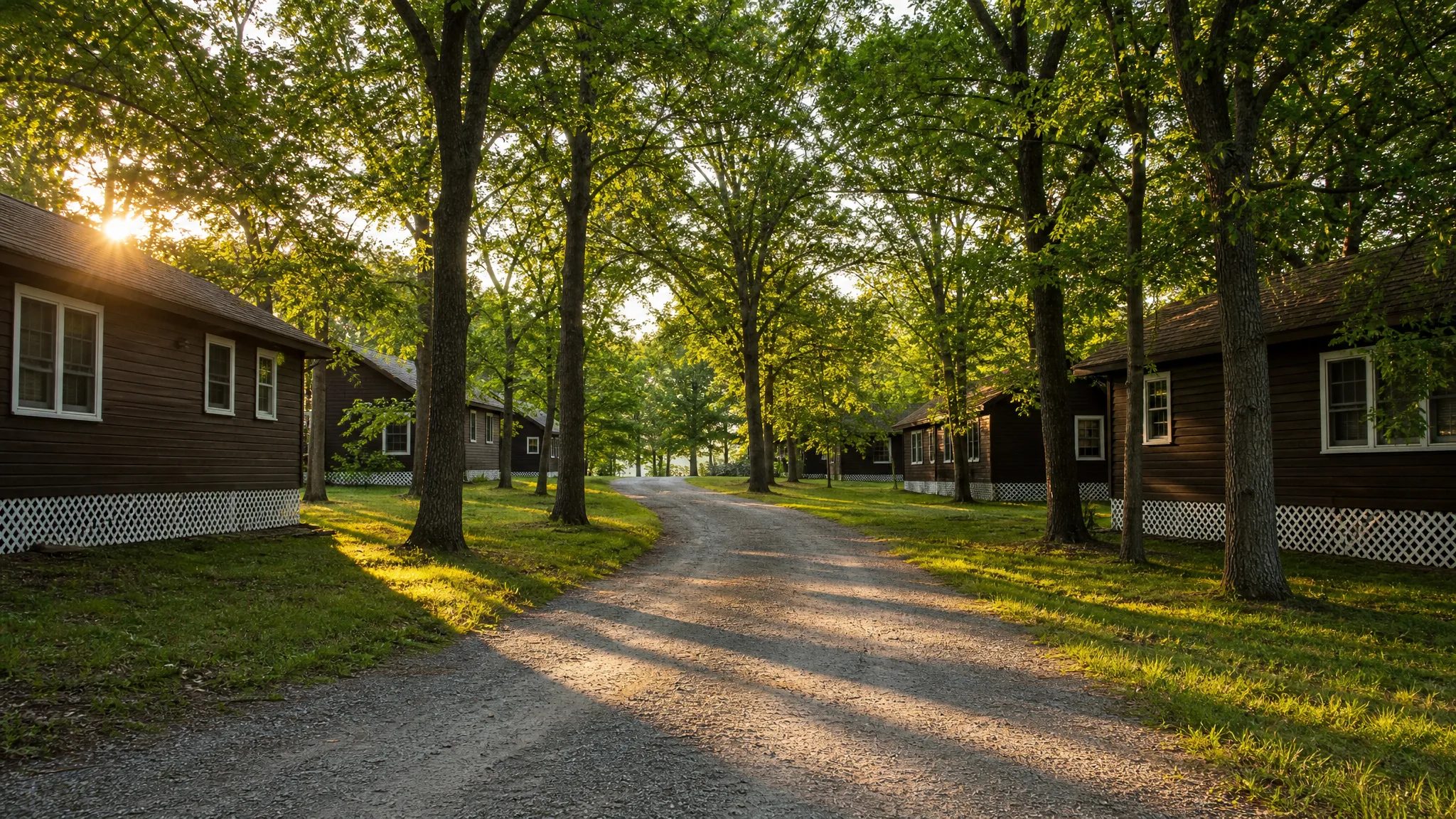
Swiss Village was the center of Turner Camp at that time and the main camping area. Tents were originally sized 12' by 14' because this was the size of World War I Army tents. They eventually built platforms and placed tents on top. In 1924, Josie Lange (Long-E) had pneumonia and was not allowed in a tent. A cottage was purchased from the Fair Store and set up. This is cottage #88. Cottages were numbered as they were built. This is why cottages are not in any sense of logical order. Some of the original cottages were sold for $250 each. The Mittlachers (Mit-locker) and the Zweifels (swi-fell) were some of the present-day Turners who were active and grew up in the Swiss Village. The dormitories, playhouse, and athletic fields were located around Mosquito Hollow and the creek. The main parking lot was where the playhouse is today.
In 1925, farmland to the east was purchased and a year later 40 more acres were purchased across the road. Four more acres were purchased along the riverfront, which is now called The Gold Coast. Today we have approximately 104 acres.
The Rathskeller finished in 1928. The base of the hill at the main entrance was dug out, with the dirt being used to level the foundation for the Dining Room and Rathskeller. The excavated area was then developed into a parking lot.
The Baren Hohle was built. If you or your family arrived at Turner Camp in the 1920s, please stand up. Thank you.
1930s
The "Gut Heil (Goot Hyle)" entrance arch was purchased from Louie's Dance Hall in Fox River Grove. Louis Cernocke (Ker-neck-ee) was "Da Man" in Fox River Grove at the time, and was also a distributor for Al Capone, who frequented his dance hall. During World War II, the "Gut Heil (Goot Hle)" lettering was changed to read "Turner Camp". The archway sign was redesigned in 1958 and changed to its present state.
The chairs in the Rathskeller were acquired from the German Pavilion at the World's Fair in Chicago.
The Ladies Clubhouse was built in 1931 and was originally named Wald Klause, or 'Forest Cottage'. The clubhouse porch was built in 1939 by C. Bleidistel (Blides-dale).
The Youth Program provided activities for both dorm and cottage kids, including gymnastics, swimming, singing, handicrafts, canoeing, hiking, rope climbing, softball, and volleyball. A campfire was held weekly, and Wilhelm Sturm (will-helm sterm) entertained with his guitar and traditional songs. The first final show was held in the dining hall with bleachers.
The beach was moved to the shore by the Gebhardt (Geb-heart) and Mutert (mute-ert) cottages in the 1930s, now referred to as 'The Old Beach'. The diving platform was built on land and carried to the water until it was neck deep. Then 15 bigger boys climbed onto the platform and jumped up and down until their legs were deep enough to make it solid. If you or your family first arrived at Turner Camp in the 1930s, please stand up. Thank you.
1940s
Canoeing was a popular activity in the Youth Program. The counselors provided quality instruction on canoeing skills and safety. Camp owned two World War II-era canoes, one 27' and the other 24'.
The Sugar Bowl was named for its bowl shape, and one volleyball court was built.
Ice and Hicks Gas began delivering propane to all cottages in the 1940's. Mail was delivered to the dining room mailboxes. Cottage #151 burned, and the fire was put out by a bucket brigade.
During the 40's & 50's, the bar in the Rathskeller was open for three meals a day, seven days a week, and used the "Honor System", with the cash register open to pay for drinks.
In 1948, the US Post Office issued a 3-cent commemorative stamp to mark the 100th anniversary of the movement in the country. If you or your family first arrived at Turner Camp in the 1940s, please stand up.
ALL SING: WE'RE CAMPERS WE'RE HIKERS CHICKEN CHASERS
1950s–1960s: FREI – FREE
1950s
Electricity was put into cottages in the early 50s. The Gold Coast was one of the first areas. There was an icehouse in the big parking lot, and it was delivered to all cottages. Newspapers were delivered daily at the front gate. The milkman and the breadman drove up the grassy hill on Flagpole Hill to deliver their products. Royden Fenton Sr would fly over Flagpole Hill and wave wings to say hello to Turners on the hill and land a seaplane on the Fox River.
In 1952, it was recognized then that widow members could own their cottages. Until that time, cottages were owned by males, and existing leases stated that upon the death of a cottage owner, his widow must join a Turner Society within 6 months, or she could not keep her camp cottage, and Turner Camp would take ownership. The Women's Auxiliary protested this to the Illinois District, saying that some widows could not financially join a society or their society was not taking women members, and these women must be protected.
The Junior House was a "booming" area for teenagers. Sock hops, ping pong, music, and "stuffing" John Humm in the closet were some of the popular activities. The house was decorated with golf flags from the Cary Country Club. Mrs. Hugi (Hugh-ghee) was one of the Juniors' sponsors. Canoeing was very popular, with trips to Fox River Grove and overnight trips to Arrowhead Island.
As many as 40 boys and 20 to 30 girls attended the dorm program weekly. Weekly dorm rates were: $12.00 for members and $14.00 for non-members. Without running water and only a well pump, face washing. All meals were served to campers in the dining hall. A friendly rivalry developed between ITC and Camp Algonquin. They had volleyball and softball contests, with ITC naturally winning most. One of the highlights of the week was the hike to the movie theater in Fox River Grove, about 6 miles round trip.
Coupon books were established to raise start-up money for Rathskellar and restaurant. Original books were $20.00. There was Square Dancing most Saturday evenings, called by George Sonnenleiter (son-i-lighter).
The new beach and seawall were built in 1953 by the Stevenson, Graham, and O'Brien cottages. A ski jump was built on the beach by Bill Garand (grand), Jay Madala (ma-da-la) and Kent Marthaler (Marth-ah-ler). They got the lumber to build the ski jumps from the "midnight lumber sales" with Warren Dalbke's (Dahlb-key's) station wagon. Royden Fenton Jr jumped in tandem with Ned Duke on his back at the 1956 Water Show.
In 1954, the Sugar Bowl was redesigned by Al Graf Sr with the help of the District Actives. It was dug out and expanded to three courts. Gus Elste (el-stee), in typical Turner tradition, filled Ballantine beer cans with concrete and placed them in the corners of each court to maintain accurate measurements from year to year. The Final Shows were moved to the Sugar Bowl.
The Milwaukee Turners taught the Schottische at the 1955 Turn fest, and the participants brought it back to camp to dance at the Rathskeller. If you or your family first arrived at Turner Camp in the 1950s, please stand up. Thank you.
1960s
The District wanted to expand its availability to all Turners and youth beyond cottage owners and started busing Turners (mostly from Aurora) to camp so that they could participate in the programs. Many turners never had the opportunity to visit the "jewel in the crown."
On August 31st, 1960, Gary Elste (el-stee) was tragically killed by a motorboat on the Fox River. A Memorial Fund was started in his memory to build a swimming pool.
In the early 1960's, the Beer Garden was built at the Rathskeller, which was later rebuilt in the 1990s.
The first Bocce Ball Tournament was held in 1963.
In June of 1964, the 50th Anniversary was celebrated, and the Invitational Turn fest was held at ITC. It was moved that, if the National Turn fest were to be held at ITC, a track needed to be built, and the hill cut back to accommodate the facility. Warren Dalbke (dahlb-key), President of Illinois District, sent a letter to the Women's Auxiliary detailing a shelter for recreation and competition alongside the track and a children's playground area. "A" field plans for enlargement were designed and implemented, completed in 1963. The track was 1/5 mile long. Cottages 71b, 150, and 156 were moved to accommodate the expansion. John Litza and Steve Hussar (huss-are) built a retaining wall that saved the "A" Field from falling back to the running track.
Turner Camp map was created in 1965 by Warren Dalbke (Dahlb-key), Dick Trankle (train-kle), and Roy Stark.
Illinois Turner Camp continued to participate in the Algonquin Founders Day Parade.
The news bulletin was initiated in 1967. Scott and Cathy Cazel (kay-zel) and George Dalbke (dalb-key) delivered the first issue to the cottage owners.
The Illinois District and Camp Committee offered 20 acres across the road for sale in May of 1969 to help pay for the purchase of a 20-acre golf course behind the Rathskeller. "Good Turner" Margaret Greiner (Kling) purchased this land with the understanding that, at the time of her death, it was returned to the National Endowment Fund because the Illinois District did not have the proper tax code to satisfy Margaret's heirs.
In 1969, Warren Dalbke (Dalb-Key) reported that ITC now has a 9-hole golf course. The Golf course ran for 3 years, then closed due to cost of maintenance. The acreage was kept as a land buffer around camp. This land was later converted to the Frisbee Golf Course by Dan Becker in Spring 2024.
If you or your family first arrived at Turner Camp in the 1960s, please stand up. Thank you.
ALL SING: MA-MA-MOSQUITO CHIPOLTE
1970s–1980s: STARK – STRONG
1970s
The organ was carried downstairs to the Rathskeller, where Dorothy Janssens (Jan-sens) played to lead others in song.
The Rathskeller was slightly flooded due to creek overflow from a 4-inch rain, and the big culvert under the bridge was built to enclose the creek.
The first Rock Concert was performed, and Kiss was the main event, with band members George Dalbke (Dalb-key), Tom Easton, Cory Litza, and Carl Adler. Produced by Steve Sonneleiter (Son-i-lighter).
The Tweenie House was established as part of the Playhouse.
The area for the tennis courts was cleared in 1974. George Knoll, Emil Feuerstein, Woody Vockroth, Ed Colton, and Ron Borck were instrumental in this project. Evergreens from across the road were brought over and placed around the tennis courts for shade. Courts were completed in 1976.
The first Tuna Tournament was held in 1975.
Construction of the swimming pool began in 1979. ITC negotiated with contractors to allow the Turners to do much of the work because we were so capable, which helped keep costs down.
If you or your family first arrived at Turner Camp in the 1970s, please stand up.
1980s
The swimming pool was completed and dedicated in 1980. 1st Pool Director was Sue Koenig. The pool patio was enlarged, and a shelter in the concession area was constructed in memory of Al and Dorothy Hain by the Hain family.
The first American Turners National Gym Camp was held in this Turner facility in 1980 and ran for 5 years. Profits were divided between the Swimming Pool Fund and the Tennis Committee. Ed Colton and Bud Marquette were the organizers of this program. The A-Field shelter was rebuilt and expanded to its current size. A foam pit was added, which is now covered.
In 1988, the Teaching Necessary Technique (TNT) was established, with Jerry Jacquin as its president. Bill Garand, President of the Camp Committee, was instrumental in the establishment of this program.
In 1989, Jerry Jacquin ran a mini turn fest at ITC. Meals were catered in, and carpools transported athletes to meals and competitions.
In 1989, the 75th Anniversary of Illinois Turner Camp was celebrated.
If you or your family first arrived at Turner Camp in the 1980s, please stand up. Thank you.
ALL SING: THE DAMPER SONG (1 verse, shout "JUST THE SAME" at the end)
1990s–2020s: TREU – TRUE
1990s
Basketball courts were built on the A-Field in the early 90s.
The playground was rebuilt near the pool by Dick Becker and Pat Boyle.
Within the Rathskeller, the Pool Room/Adult Room was built, started by Barb Hugi. (It was used to secure the beer and pop storage.)
1994-1995, the Barrel Heads were recreated by George Gebhardt, Fred Gebhardt, Roy Stark, and Steve Hussar. The original hand-carved barrel heads hung in the Raths for 50 years until they were stolen in 1973. Appreciation to the Carl Potthast family for furnishing the artwork to reproduce these figures.
If you or your family first arrived at Turner Camp in the 1990s, please stand up. Thank you.
2000s
The Swimming Pool was refurbished and maintained through the leadership of Cory Litza and the Swimming Pool Committee. Donna Litza, Jack Bucaro, Steve Paupa, Cheryl Mittlacher, and their committees organized Swimming Pool Refurbishing Dinner Parties to raise funds. In 2004, the in-ground hot tubs were removed. New shelters were placed to cover the baby pool and picnic tables. A company refurbished the pool in 2008, but the paint flaked, and they took most of the summer to repair it. The Camp Staff of that year is to be commended for continuing without the use of the pool. Through their insight and dedication, the great Turner Camp Program was effectively run throughout the summer.
The Illinois District approved funds in 2006 to refurbish the Tennis Courts and in 2007 to buy new standards for the Sugar Bowl volleyball courts. Bill Alles Jr., Jerry Jacquin Jr., Rick Trankle, and Kurk Lingner provided the workforce to level and redesign the three courts.
Talent shows returned in 2007.
The Rathskeller bar was rebuilt in 2007 by Jack Bucaro.
Grandpa Ron Borck read to Tiny Tots each week during the camp program.
If you or your family first arrived at Turner Camp in the 2000s, please stand up. Thank you.
2010s
In 2014, the 100th anniversary was celebrated with an adult mass drill. The Rathskeller murals were restored by Bridget McHugh in June. The Gut Heil (Goot Hyle) archway was restored and installed in a centennial memorial garden, between the Barenhole and the Ladies Clubhouse.
In 2015, Amy Oatie organized the first Turner Trot to raise money for a new playground. Just three years later, the new playground was installed, and the Turner Trot continues today.
If you or your family first arrived at Turner Camp in the 2010s, please stand up. Thank you.
2020s
The Art Studio opened in 2022. Coming soon: an expansion to include an upstairs textile studio.
In the Spring of 2024, Dan Becker completed the excavation of the frisbee golf course and hiking trail in the woods behind the Rathskeller. Gregg Kusch won the first annual Frisbee Golf Tournament.
Also in 2024, major renovations were completed at the Rathskeller, including a new roof, new windows, a new floor, and the removal of the walk-in freezer. Tom Turner refinished the tables.
The Candy Store was repainted and updated by Patty Richter and Caitlyn Clements.
If you or your family first arrived at Turner Camp in the 2020s, please stand up. Thank you.
ALL SING: DUMKAUFFER (last verse with all body parts, "YA VOL")
ALL SING: NOW RUN ALONG HOME
Closing
Cory Litza Speech · Closing Song
ALL SING: NOW RUN ALONG HOME
If There Were No Turner Camp
Written by: Turner Al Graf
If there were no Turner Camp
How stranded we would be.
On every weekend,
What to do and what to see.
Nowhere to shape up, wake up, and drink up.
Wouldn't that be the living end?
There's no Turner Camp, my friend,
That down there is Hager's Bend.
Our sports and games, our races too,
Mean more to us than play.
But where will all this happen,
There's no Turner Camp today.
No volleyball, no track and field,
No wandering down our paths.
No water fun along the Fox,
Be honest, friends - gives us all some shocks.
If that cottage were not there,
Does that give you quite a scare?
Some people might not care,
I'd work harder just to keep it there.
Pinch me, pal. Is this a dream?
There is a camp! A camp supreme
founded by true hardworking Turners!
With 'health is wealth,' it's a master scheme.
Traveling in and traveling out
took a heart that's mighty stout.
In touring cars and choo-choo trains,
They made it friends, Did not complain.
Some work! Some tents! A Camp!
The founders did a lot of giving.
On every living weekend,
They spent time living.
I'm glad to be a Turner.
Not just on the weekends.
An pitch in when I'm needed
To do the odds and ends.
I'm glad there is a camp today.
Where Turners all ages come to play.
There is no place like it my friend,
In the living U.S.A.
Keep Exploring Our History
Watch the documentary, or read how the Illinois District grew from the first Chicago Turnvereine to the village on the Fox River.